Client
A leading US-based hospitality group with 13 distinctive sub-brands and over 7 million active loyalty members. The client wanted to maximize corporate EBITDA, rapidly onboard newly acquired properties, and bypass high OTA commission fees by transforming its digital platform into an optimized, high-conversion direct-booking engine.
Eclept. provided
UI/UX Design: Redesigned a unified global homepage, 13 distinct sub-brand landing pages, and a friction-free mobile search and checkout experience.
Frontend Development: Built a high-speed, server-side rendered mobile-first web framework using Next.js integrated directly with Contentful CMS to support multi-brand digital assets.
Backend Development: Developed a scalable TypeScript-based backend, custom API middleware, and a custom plug-and-play HTNG connector to bridge legacy reservation systems.
Infrastructure Setup: Configured a highly scalable hosting solution optimized for Server-Side Rendering (SSR) and Content Delivery Networks (CDNs), set up robust cache invalidation linked directly to content updates, and deployed automated proactive anomaly monitoring.
Integrations & Compliance Setup: Implemented OKTA security with passwordless Passkey authentication, the Shift4 gateway with custom payment resilience fallbacks, Osano-driven privacy compliance, and integrated dynamic digital wallet options.
SLA Support: Provided ongoing post-launch maintenance, bug fixes, software and content updates, and performance optimization support.
Project
The primary strategic roadmap for our US-based hospitality client focuses on improving corporate EBITDA by transforming the digital platform into the brand’s number-one sales channel. The commercial objective is straightforward: surpass $200 million in direct digital revenue.
To hit this goal, execution of a two-pronged growth strategy was needed:
- Expand Offerings: Drastically expand the property and destination options available to guests by leveraging an active loyalty pool of 7 million users.
Acquiring smaller hospitality businesses provides immediate market scale, but with historical integration paths simply taking too long to serve as fast revenue drivers.
A faster, plug-and-play onboarding infrastructure is required to monetize new properties instantly. - Maximize Margins: While property acquisitions provide immediate market scale and net unit growth, capturing those reservations through proprietary channels ensures the new footprint operates at peak profitability rather than leaking 15% to 25% of its volume value to high Online Travel Agency (OTA) commissions.
A new way of interacting with guests/members needs to be designed that would shift volume away from expensive third-party agencies (like Booking.com, Expedia, and Agoda). To achieve this channel shift, a new, friction-free experience must be designed to engage consumers directly. Additionally, not only registered users, but guests need to see offers in a redefined way.
The platform needs scaling total booking volume
“while retaining $0.95 of every dollar spent”.
Part 1: Aggressive Acquisitions Scalability
To achieve its target of net unit growth, an aggressive property acquisition model was created. It was clear how the target business was scanned and due-diligence done fast. But historically, corporate acquisitions required lengthy, multi-month technology migrations before the newly acquired hotels could contribute to parent brand revenue. This needed to change. Parent brand needed fast integration of acquired brands under their own technology for this model to work.
The Business Value of the Master-Subordinate Bridge
When acquiring a parallel hotel chain, the new properties typically run on an independent legacy Central Reservation System (CRS). Instead of undertaking a high-risk, immediate database cutover, we implemented an API-driven CRS-to-CRS bridge. The main CRS acts as the corporate distribution hub, while the acquired brand’s legacy CRS functions as a “Property Management System” (PMS) feed. This was achieved utilizing standardized HTNG data transmission protocols. We created an agile blueprint to instantly monetize new inventory, without disruptions.
The moment the HTNG CRS-to-CRS bridge is turned on, the newly acquired hotels are mapped as a sub-brand inside the primary booking system. This means the existing database of 7 million loyal guests can immediately view, search, and directly book rooms at the new properties.
You instantly drive occupancy to the new assets without spending a single dollar on guest acquisition marketing
- Instantaneous Global Inventory Monetization: Using HTNG Express interfaces, the acquired system pushes live room blocks, rate structures, and availability constraints upward into our main hub. This inventory is immediately bookable across all global channels, maximizing cross-selling from day one.
- Frictionless Real-Time Fulfillment: The moment a traveler purchases a room, the platform utilizes the HTNG Property Connect protocol to transmit the reservation data, room specifications, and loyalty account records directly down to the acquired brand’s database.
- Zero On-Property Disruption: Hotel managers and front-desk personnel at the newly acquired properties continue using their familiar local interfaces. There is zero downtime, zero initial retraining expense, and immediate top-line revenue capture.
The Three-Phase Migration Lifecycle
- The Architecture Alignment: Middleware components establish secure HTTPS endpoints to process the underlying HTNG schemas while engineers map disparate room designations and brand identifier codes
- The Bridged Revenue: The live HTNG interface is activated. The acquired chain continues operating its legacy standalone website, but its entire inventory simultaneously populates the central search results grid
- The System Decommission: Over the following fiscal quarters, individual properties are systematically moved onto the unified SynXis cloud infrastructure, allowing clean wind down and decommission the legacy CRS licensing costs.
Part 2: Direct Customer Engagement
With over 60% of web traffic originating from mobile devices, traditional desktop-first outreach models are no longer sufficient. To overcome the low engagement rates of standard post-stay marketing emails (which hover around 20%), we launched a targeted Mobile Digital Wallet pilot program designed to create a persistent digital relationship with guests.
Eliminating the Cognitive Burden
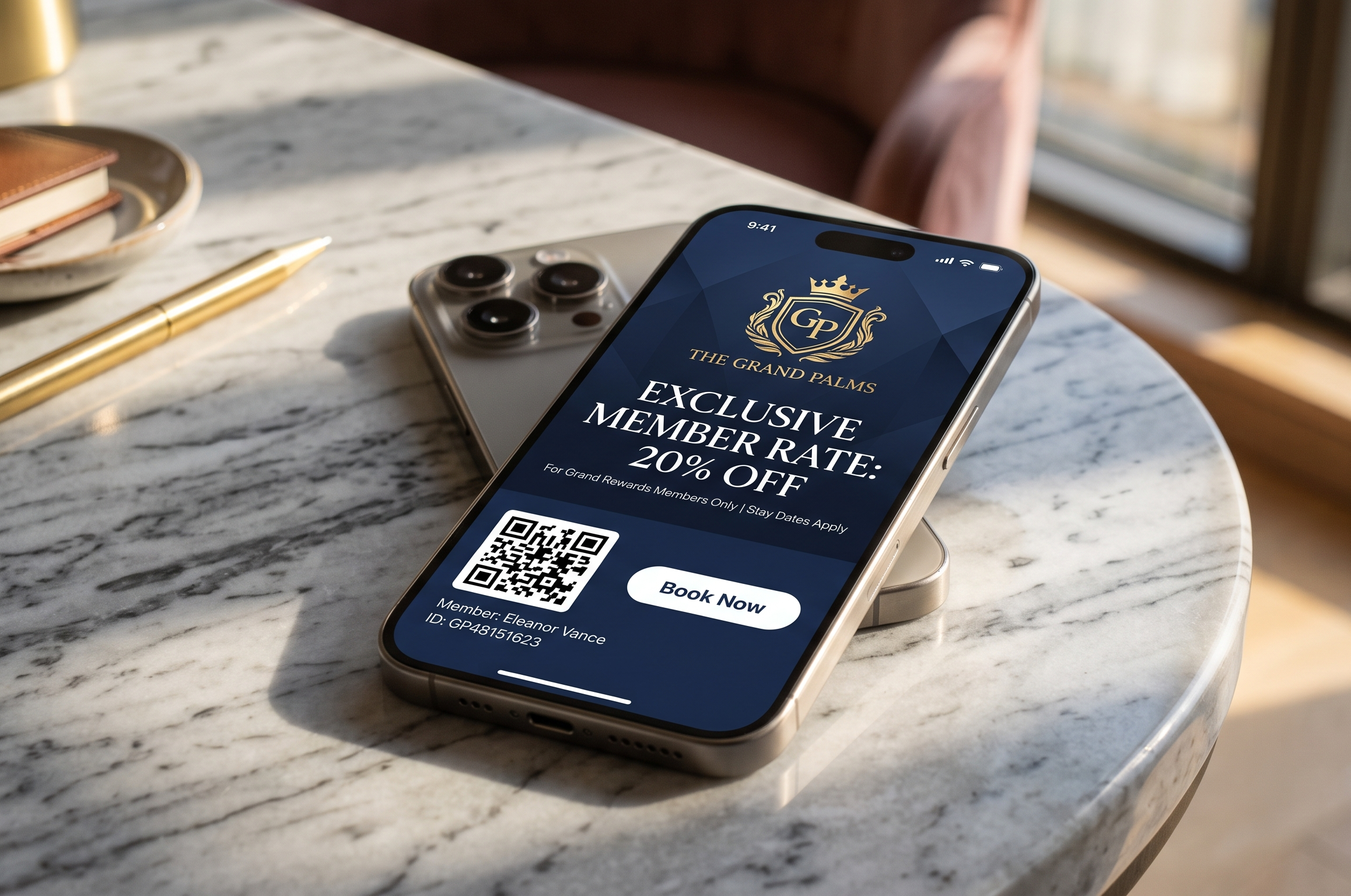
The core strategy of this mobile pilot is to remove the “cognitive memory tax” from the customer. Rather than printing physical welcome fliers that end up in the trash, or sending promotional discount codes that get lost in crowded email folders, We deliver a native, dynamic card that sits directly inside your phone digital wallet (Apple Wallet or Google Wallet).
The Low-Friction Ingestion Loop
To bypass the friction of standard mobile app downloads, which require app store authentication and large storage footprints, the wallet pass uses a lightweight, two-click ingestion framework:
- Omnichannel Distribution: The pass link is distributed passively via physical QR code displays at Global Sales Organization (GSO) trade shows, and actively via automated “Bounce-Back” post-stay outreach emails triggered immediately upon property checkout.
- Native Cryptographic Minting: Clicking the link invokes a Next.js serverless API function that securely communicates with a 3rd-party Pass SaaS provider. The system passes campaign rules managed in Contentful CMS and signs the asset using verified corporate Apple Business Token, instantly sliding a tokenized, unique pass object onto the user’s device.
The Location-Aware Conversion Loop
Once accepted onto a smartphone, the digital wallet pass stops being a static coupon and transforms into an active, automated marketing channel that functions completely independent of any native mobile app installations.
Zero-Battery Hardware Geofencing
Every unique wallet pass is pre-compiled with up to 10 localized geographic coordinates corresponding to major travel hubs, regional transit centers, and corporate airports.
- The pass leverages the smartphone’s core operating system (iOS and Android) to monitor these coordinates natively at the hardware layer.
- Because it utilizes core OS location frameworks, it operates with 0% background application battery drain.
- When a traveler checks in at an airport or enters a designated city radius, the phone automatically wakes up, displaying a targeted, high-visibility prompt directly on their lock screen: “Save up to 20% on stays at…”
Scaled Footprint, Maximized Margins
By aligning rapid property onboarding via the HTNG bridge with a high-conversion mobile wallet loop, the client is ready for its aggressive roadmap targeting a Q2 2026 launch.
This digital transformation effectively proved that rapid expansion and margin protection can co-exist within a single, unified framework. Rather than allowing acquisitions to dilute portfolio yield through immediate reliance on third-party OTAs, the modern architecture is turned into a powerful customer acquisition tool from day one.
This was verified by a couple of pilot acquisitions with special focus on speed of integration, bringing value faster than ever.
Key Strategic Deliverables
- Financial Integrity Guardrails: The platform is already shifting market share back to proprietary channels, protecting the client’s Average Daily Rate (ADR) and establishing a definitive path to exceed $200 million in direct digital revenue while retaining $0.95 of every dollar generated.
- Decoupled Agility Over the Legacy “Black Box”: Transitioning from an insecure, rigid legacy ecosystem to a hybrid Next.js frontend and Contentful CMS structure eliminated historical operational delays, dropping content publish queues from 13 minutes down to real-time execution.
- Frictionless Conversion Mechanics: Deploying the in-context SynXis booking engine layer and bypassing standard mobile app download barriers resolved the client’s historical room-booking limitations, successfully positioning the web platform to capture the 60%+ of users browsing via mobile devices.
The Forward Roadmap
With the foundational platform layers securely established, the architecture is primed to move from the pilot phase into long-term commercial maximization:
- Vanity Site Consolidation: The team will begin systematically absorbing the remaining 40+ legacy vanity websites directly into the centralized Contentful multi-tenant infrastructure to eliminate duplicate licensing footprints.
- Authenticated Loyalty Scaling: The unauthenticated digital wallet coupon cards will be upgraded into permanent, authenticated digital membership passes. These will link directly with the OKTA portal to display dynamic point balances, tier milestones, and stored preferences natively on the user’s phone.
Build Your Hospitality Vision with Eclept.
Are you looking to develop a custom hospitality solution or to speed up development?
Eclept has the expertise to bring your ideas to life quickly, reliably, and cost-effectively.
Contact us today to discuss your project requirements and learn how we can help you achieve your goals.
Case Studies
Andrea360: Modern Gyms Backbone
Milan Deket
HealthConnect – Telehealth Platform for Growing Practices
Boris Petelj
IoT for Baby Care Industry
Milan Sekulić
TeleHealth Platform Incorporating Insurance Policies
Boris Petelj
ECLEPT
Stay Ahead with Expert Insights
Get the latest trends in software development, tech innovations, and industry insights—straight to your inbox.