



Temporary CTO is a term loosely used to describe either a Fractional or Interim CTO. When Interim and Fractional CTOs are compared the conversation usually starts with logistics. One is full-time. The other is part-time. One fills a temporary leadership gap. The other provides ongoing executive guidance.
While those distinctions are accurate, they don’t explain what really determines whether a temporary technology leader succeeds. The most overlooked difference between the two roles isn’t their engagement model, availability, or even their experience. It’s accountability. And accountability is what ultimately creates (or destroys) trust.
Technology Leadership is an Exercise in Trust
Every CTO, whether permanent or temporary, is entrusted with decisions that have far-reaching consequences. A CEO trusts them to align technology with business strategy. Engineering teams trust them to set technical direction. Investors trust them to protect technology investments.
Customers trust them to deliver reliable, secure products.
Technology leadership is fundamentally about trust. When that leader is temporary, trust doesn’t become less important, it becomes more difficult to establish. A permanent executive has months, or even years, to build credibility. A temporary executive may have only days or weeks before they are expected to make critical decisions. That’s why understanding accountability is more valuable than simply comparing job descriptions.
Two Roles, Similar Responsibilities
At first glance, Interim and Fractional CTOs appear remarkably similar.
Both may:
- Define technology strategy
- Review software architecture
- Advise the CEO and executive team
- Mentor engineering managers and technical leaders
- Influence hiring decisions
- Assess technical risks
- Improve engineering processes
- Represent technology in discussions with investors or the board
On paper, the responsibilities overlap significantly. So why do these roles feel so different in practice? Because responsibilities don’t necessarily imply ownership.
Accountability Changes Everything
Imagine two experienced CTOs walking into the same company. Both recommend modernizing the platform. Both identify delivery bottlenecks. Both propose changes to engineering processes.
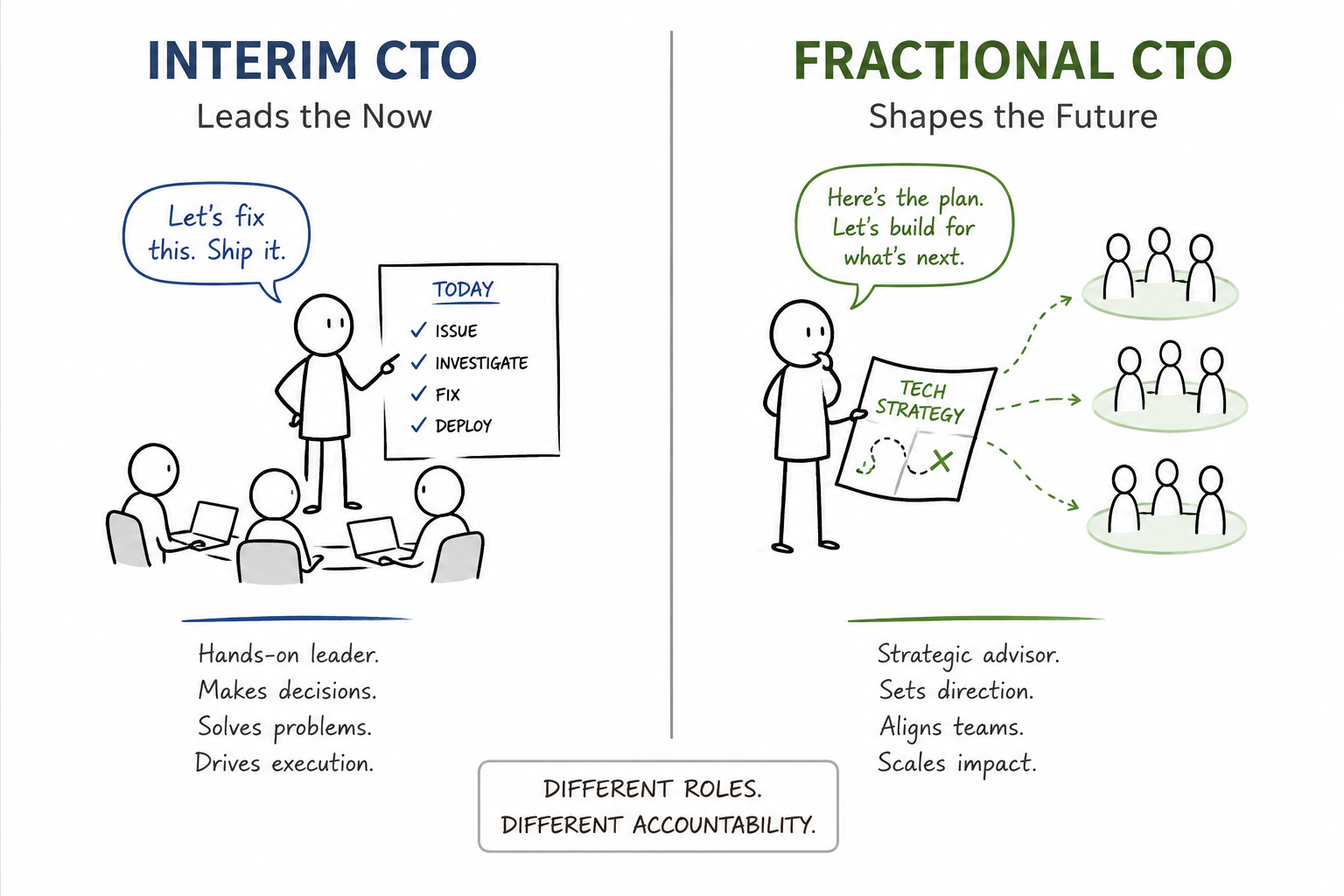
But only one of them is expected to own the outcome. That’s the Interim CTO. An Interim CTO typically steps into an executive vacancy or leads the technology organization through a period of transition. They become responsible for the day-to-day operation of engineering.
If product delivery slows down, they’re accountable. If a major incident occurs, they lead the response. When key engineers leave, they manage the consequences. When the board asks why strategic initiatives are delayed, they are expected to provide the answer. The organization isn’t simply asking for their opinion.
It’s trusting them to run the technology.
A Fractional CTO operates differently. They remain accountable for strategic guidance, technical direction and executive advice, but operational ownership often stays with the existing engineering leadership. They influence decisions rather than execute them directly. Their success depends less on organizational authority and more on their ability to help others make better decisions.
Neither role is inherently more valuable. They simply carry different kinds of accountability. This difference in accountability creates two distinct models of trust.
The Fractional CTO: Trust Through Expertise
A Fractional CTO is invited into an organization because of experience. They have seen similar technical challenges before. They recognize patterns. They bring perspective from multiple companies, industries and growth stages.
People trust their judgment because of what they know. Their influence comes from credibility rather than formal authority. Engineering leaders aren’t following orders. They are choosing to act on recommendations they believe will improve outcomes. This is trust built on expertise.
The Interim CTO: Trust Through Ownership
An Interim CTO must earn trust in a different way. They don’t just advise. They decide. They prioritize roadmaps and approve budgets. They manage engineering leaders. They represent technology at the executive level. And most importantly, they own the consequences of those decisions.
The question facing the organization isn’t about agreeing with the recommendations. It’s about being comfortable letting that person lead the technology organization.
That’s a much higher threshold. Expertise gets an Interim CTO through the door. Trust gives them the authority to lead.
The Trust Equation
One way to think about temporary technology leadership is through a simple equation:
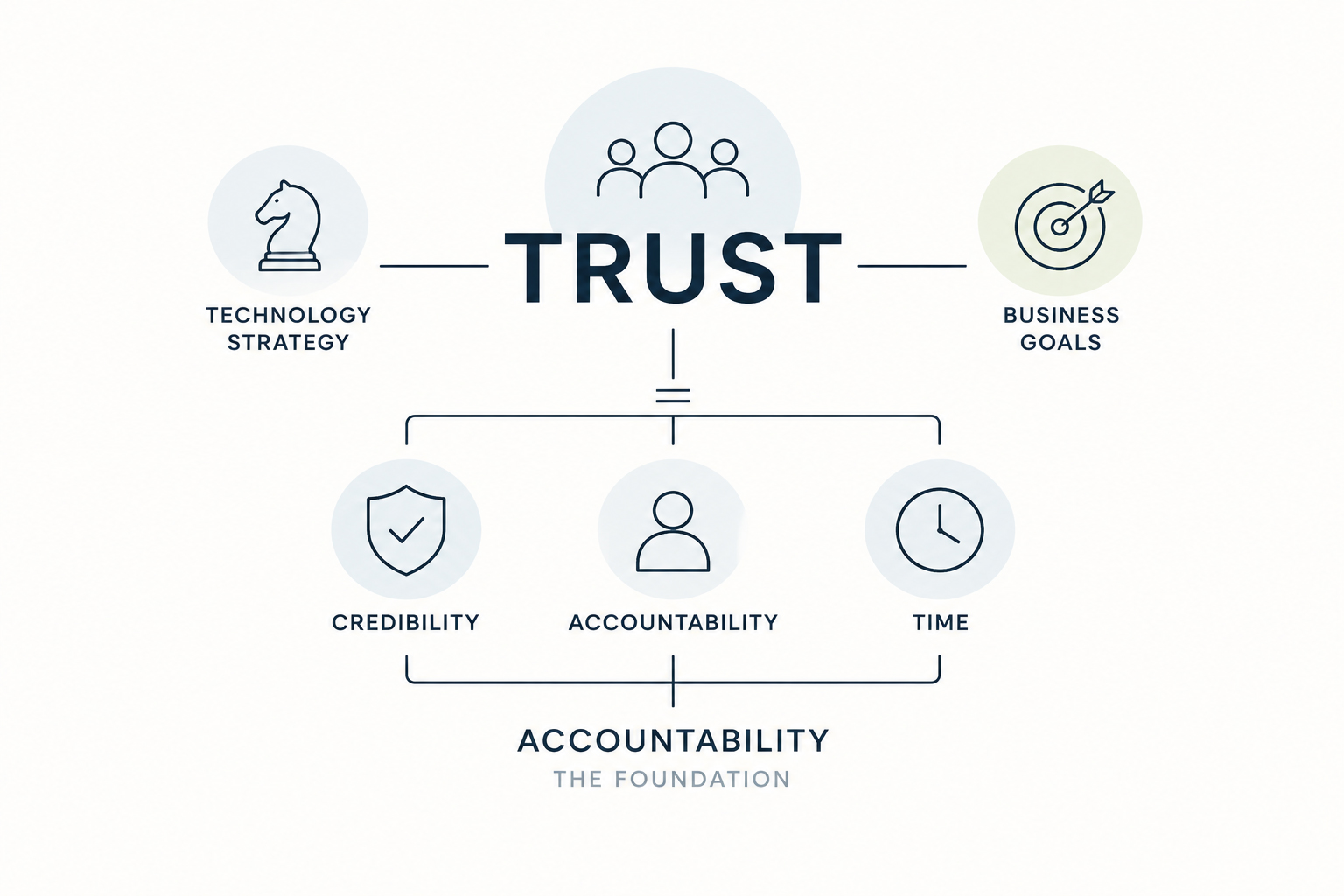
Trust = Credibility × Accountability × Time
Each element matters.
- Credibility answers the question: Does this person know what they’re doing?
- Accountability answers: Are they responsible for the outcome, or simply advising?
- Time reflects how long they have to earn confidence.
Permanent CTOs benefit from time. Temporary CTOs usually don’t.
An Interim CTO may be expected to lead executive meetings, resolve production incidents and make hiring decisions within their first week. A Fractional CTO often has more time to build relationships, understand the business and gradually influence strategic direction.
Neither role has an easier path. The trust simply develops differently.
Why Companies Often Get This Wrong
Organizations sometimes assume that hiring a temporary CTO is primarily about filling a gap in experience. In reality, they’re filling a gap in leadership.
If the company needs someone to own delivery, manage engineering and make executive decisions every day, hiring a Fractional CTO may leave an accountability gap. Conversely, bringing in an Interim CTO when the business only needs strategic guidance can introduce unnecessary cost, process, and organizational complexity.
The question shouldn’t be: “Do we need an Interim or a Fractional CTO?”
The better question is: “Where do we need accountability?”
If accountability needs to sit inside the technology organization every day, an Interim CTO is likely the right choice. If accountability already exists within engineering leadership but strategic guidance is missing, a Fractional CTO may deliver far greater value.
Trust As the Real Deliverable
Technology strategies can be documented. Architectures can be redesigned. Processes can be improved. Those are important outcomes. But they are rarely the reason a temporary technology executive succeeds.
Successful Interim and Fractional CTOs leave something more valuable behind. They create confidence. Confidence that the technology strategy is sound. Confidence that engineering is moving in the right direction. Confidence that difficult decisions are being made with both technical excellence and business priorities in mind. That confidence is built on trust. And trust is earned through accountability.
Conclusion
The distinction between an Interim CTO and a Fractional CTO isn’t simply how many days they work each week or how long they stay with the company.
It’s the level of accountability they are expected to assume. And the trust required to carry it.
Understanding that distinction helps organizations choose the right kind of technology leadership, not just the right title.
Boris Petelj
Chief Technology Officer, Eclept
Related News
Eclept – Year in Review 2025
Ivan Lazarević
Incremental Processing in ETL
Matija Mijalković
When the Backend Doesn’t Check Who You Are: Inside the FIFA IDOR Breach
Dark Patterns as a Business Model: The Engineering Ethics of Conversion at Scale
Ivan Lazarević
Let’s build something great together!
30 min
Meet
“Every successful project starts with the right conversation. We’re here to listen, strategize, and find the best way forward—together.”